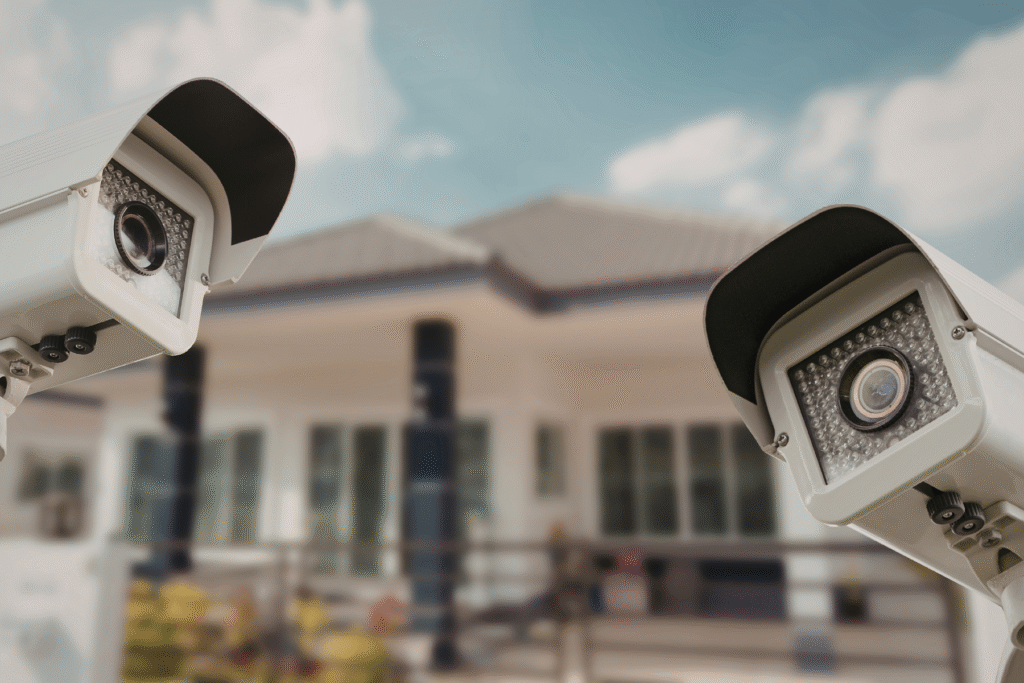
Security cameras, particularly Ring Doorbells, and other video recording devices are becoming increasingly common. As this technology has evolved through the years, Illinois community associations are seeing an uptick in surveillance and security camera usage. Although this technology can bring peace of mind to individual unit owners, Illinois community associations may be apprehensive about installing these devices, as they can pose significant legal risks. This article will discuss the potential risks Illinois community associations face regarding security cameras and other video recording devices, and offer practical tips to reduce exposure.
Illinois Community Associations Should Require Approval Before Permitting Installation of Video Recording Devices
The location of a security camera installation can be an issue for community associations. In many Illinois condominium associations, exterior doors, door frames, hallway walls, and the building façade are common elements. While unit owners may view a doorbell camera as a minor add-on, these installations are physical modifications of the common elements. Most Illinois community associations require written board approval, in the form of a written modification agreement. before a unit owner may modify the Common Elements.
Audio Recording Can Pose Liability to Illinois Community Associations under the Illinois Eavesdropping Statute
Illinois is considered an “all-party consent” state for recording private conversations. The Illinois eavesdropping statute (720 ILCS 5/14-1) generally criminalizes recording a private conversation without consent of all parties, with limited exceptions. Often, Ring Doorbells and other video recording devices not only record video but also audio when individuals walk past or approach them. A doorbell camera placed at a unit entrance can inadvertently capture hallway conversations, neighbor disputes, board members speaking outside a door, vendor discussions, or even conversations inside a nearby unit if a door is open. Owners often do not realize that their device records audio by default. By recording other unit owners without their consent, not only may the unit owner who owns the video recording device be liable under the Illinois eavesdropping statute, but the Illinois community association that approved the installation may also be liable. Accordingly, Illinois community associations that permit Ring Doorbells and other security cameras should adopt rules and regulations requiring audio to be disabled and requiring owners to certify in writing that the device will not record audio.
Video Recording Devices Can Pose Privacy Risks to Illinois Community Associations
Security cameras installed in shared hallways can pose privacy risks. Associations must ensure that security cameras installed by unit owners will not record any area where other owners have a reasonable expectation of privacy, such as within another owner’s unit. Illinois caselaw indicates that video recording devices are generally acceptable so long as the devices do not record areas where individuals have a reasonable expectation of privacy. In Schiller v. Mitchell, 357 Ill. App. 3d 435, 828 N.E.2d 323 (2d Dist. 2005), a homeowner affixed a camera that was aimed directly at a neighbor’s home, and the plaintiffs discovered that the defendants were using the camera to surveil the plaintiffs and the plaintiffs’ property. The Illinois appellate court held as follows:In contrast to Benitez and Acuff, plaintiffs in the instant case have not pleaded that defendants’ surveillance camera captured any private activity. The locations involved in Benitez and Acuff, a restroom and a medical examination room, were private by their nature. Here, the complaint alleged merely that the camera was aimed at plaintiffs’ garage, driveway, side-door area, and backyard. The complaint does not explain why a passerby on the street or a roofer or a tree trimmer could not see what the camera saw, only from a different angle. We conclude that plaintiffs have not pleaded facts that satisfy the privacy element of the tort of intrusion upon the seclusion of another. Accordingly, the trial court did not err in dismissing count I of the complaint. Schiller at 239. Accordingly, Illinois community associations should permit unit owners to install security cameras so long as the unit owner can attest that the video recording device will not record any area where owners reasonably expect privacy. Although a unit owner has a reasonable expectation of privacy in their unit, there is no such expectation in the association’s common elements, such as hallways. Regardless, Illinois community associations that receive requests to install video recording devices should discuss the legal risks with counsel before responding.
Illinois Community Association Should Properly Maintain Security Cameras It Owns and Operates
Many Illinois community associations concerned about potential criminal activity want to install security cameras around buildings they own and control. Illinois community associations that install these security cameras should perform regular maintenance to ensure they are functioning correctly at all times. Illinois follows the voluntary undertaking doctrine. Under this doctrine, a community association may be held liable for the criminal acts of third parties when it voluntarily undertakes to provide security measures, but performs the undertaking negligently, if the negligence is the proximate cause of injury to the plaintiff. Bourgonje v. Machev, 362 Ill. App. 3d 984, 995, 841 N.E.2d 96, 107 (2005). As such, the Association will want to ensure the cameras are correctly maintained. Furthermore, to protect against potential liability arising from third-party criminal acts, Illinois community associations should amend their governing documents to include a disclaimer of liability for such acts. The typical language we would recommend is as follows: The Association may, but is not obligated to, take such action as it deems appropriate to address potential security concerns within the Condominium or at an Association activity. No representation or warranty is made that any security measures undertaken by the Association will prevent damage to Person or property caused by third parties. Each Unit Owner acknowledges, for themselves and their tenants, occupants, invitees, and licensees, that they assume the risk that criminal acts of third parties may occur on the Common Elements or at an Association activity. Further, each Unit Owner, for themselves and their tenants, occupants, invitees, and licensees, waives any liability against the Association, its agents, and any volunteer Board members, committee members, or officers for any damage, injury, or loss to Person or property arising from or related to the criminal acts of third parties, a failure to provide adequate security, or ineffectiveness of any security measures undertaken by the Association. Although there has been no case in Illinois addressing this type of disclaimer of liability, Illinois courts have held that exculpatory clauses are generally enforceable. See Harris v. Walker, 119 Ill. 2d 542, 519 N.E.2d 917 (1988) and Spears v Ass’n of Illinois Elec Co-op, 986 NE2d 216 (Ill App Ct. 2013). Accordingly, Illinois community associations concerned about third-party criminal activity within their associations should seek to amend their governing documents to include language disclaiming liability for third-party criminal acts, further insulating the association from liability.
Conclusion
While many owners in Illinois community associations install security cameras to address package theft and other safety concerns, these devices can also pose legal risks. o minimize liability and ensure compliance with Illinois law, condominium and homeowners associations should consider the following:
- Adopt Rules and Regulations specifying where video recording devices may be installed and under what conditions to avoid potential privacy concerns.
- Require board approval through a written modification agreement before an owner installs a device on the common elements.
- Prohibit audio recording to avoid liability under the Illinois eavesdropping statute (720 ILCS 5/14-1).
- Amend the declaration or bylaws to include disclaimers of liability for criminal acts committed by third parties, as well as creating specific requirements related to the installation of Ring Doorbells and security cameras. For example, if an association wants to permit Ring Doorbells without requiring a written modification agreement, it may require an amendment to the bylaws.
- Consult experienced community association counsel before responding to any owner request or installing surveillance systems.
If your Illinois condominium or homeowners association needs assistance with preparing a modification agreement, drafting video surveillance rules, or amending your bylaws to include a liability disclaimer, the attorneys at Hirzel Law, PLC are here to help. Contact us today to protect your association and reduce legal exposure.