
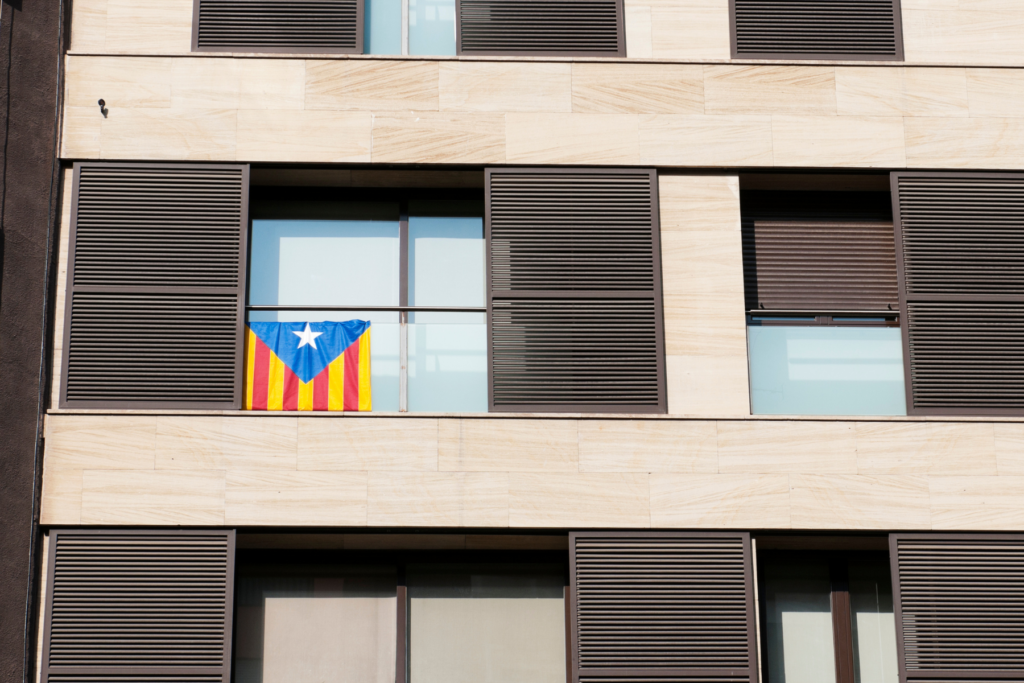
Can an Illinois community association enforce a “neutral” policy banning conflict-related flags without violating the Fair Housing Act? A recent decision from the United States Court of Appeals for the Seventh Circuit says it can, at least where the policy is applied evenhandedly and the resident frames the dispute as one about political viewpoint rather than national origin.
A recent decision from the United States Court of Appeals for the Seventh Circuit, Farhan v. 2715 NMA LLC, 161 F.4th 475 (7th Cir. 2025), provides important guidance on on when a facially neutral flag policy crosses the line into housing discrimination. This article summarizes the facts of the case, discusses the court’s analysis, and offers practical takeaways for Illinois community associations navigating similar situations.
Background: A Palestinian Flag and a “Neutrality” Policy
Manal Farhan is a first-generation Palestinian American who, beginning in 2021, leased an apartment from 2715 NMA LLC (the “Defendants”). In October 2023, following the escalation of the Israel-Palestine conflict, Farhan handmade a Palestinian flag and displayed it outside her apartment window to show solidarity with the Palestinian people.
Shortly thereafter, the building’s property manager called Farhan and told her the building had received a complaint about the flag. The property manager explained that “because there is a conflict [in Gaza], we want to stay neutral” and instructed Farhan to remove her flag pursuant to a purported “neutrality” policy requiring all tenants to refrain from displaying any symbols related to the Israel-Palestine conflict. Farhan then informed the property manager that she was Palestinian and that she was flying the flag to “express love and pride in her heritage.” The property manager responded that this was “unacceptable” and warned that Farhan would be evicted if she refused to stay neutral.
Farhan did not remove the flag. Nine days later, she received a ten-day notice of termination of her tenancy. The notice cited a lease provision regarding the display of items outside windows, but Farhan alleged this reason was pretextual, as the property manager had told her she would not be permitted to fly the flag even if it remained entirely inside her unit. Farhan also noted that other tenants displayed flags, artwork, and holiday decorations in their windows in a similar manner without receiving termination notices. However, she did not allege that any of those tenants displayed flags or symbols specifically relating to the Israel-Palestine conflict.
Farhan filed suit in Cook County Circuit Court, alleging that Defendants violated the Fair Housing Act and several state laws. The Defendants removed the case to federal court. The United States District Court for the Northern District of Illinois granted Defendants’ motion to dismiss, finding that Farhan failed to state a plausible claim for national origin discrimination. Farhan appealed to the Seventh Circuit.
How the Seventh Circuit Analyzed the Fair Housing Act Claim
The Seventh Circuit affirmed the district court’s dismissal, though its ruling was limited to the specific arguments Farhan raised below and on appeal.
Disparate Treatment: No Allegation of Intent Based on National Origin
To succeed on a disparate treatment claim under the Fair Housing Act, a plaintiff must plausibly allege that the defendant acted because of the plaintiff’s protected status. The court found that Farhan’s complaint came up short on this front for two reasons.
First, the complaint did not allege that Defendants created or enforced the neutrality policy because of Farhan’s national origin. The policy, as Farhan herself described it, applied to “tenants of Defendants” across the board, and it was not alleged to target Palestinian tenants specifically, or to allow Israeli flags while banning Palestinian ones. The court noted that if Farhan had alleged, for example, that a non-Palestinian tenant flew a Palestinian or Israeli flag without Defendants intervening, it might have been able to infer discriminatory intent. Without that kind of allegation, no such inference was available.
Second, Farhan had consistently framed her claim throughout the litigation as one of viewpoint discrimination, not identity discrimination. In opposing Defendants’ motion to dismiss, she argued that “requiring tenants to stay neutral in a conflict concerning their home countries is national origin discrimination” and told the court that “this would not be happening if she flew a Ukrainian flag in her window instead of a Palestinian one.” The Seventh Circuit held that while political expression relating to one’s heritage may implicate national origin, a policy targeting political conduct does not automatically become national origin discrimination under the Fair Housing Act. The Fair Housing Act does not protect against discrimination based on political expression.
The court acknowledged that Farhan might have stated a viable Fair Housing Act claim had she alleged that Defendants moved to evict her because she is Palestinian. But Farhan never pursued that theory, and the Seventh Circuit declined to construct arguments on her behalf.
Disparate Impact: No Statistical Basis for the Claim
The Seventh Circuit also rejected Farhan’s disparate impact theory. For a disparate impact claim under the Fair Housing Act, a plaintiff must plead facts establishing a causal connection between a challenged policy and a disproportionate adverse impact on a protected class. That means alleging some statistical or proportional basis for concluding that the policy harms members of the protected class more than others.
Farhan’s complaint offered no such factual foundation. She did not allege how many tenants were subject to the neutrality policy, how many had been affected by its enforcement, or how the policy’s burden fell differently on Palestinians compared to non-Palestinians. The Seventh Circuit found it insufficient to assert that the policy “negatively impacts Palestinians.”
Key Takeaways for Illinois Community Associations
Farhan offers several lessons for Illinois community associations that maintain flag, sign, or window-display policies.
- Facially Neutral Policies Must Be Consistently and Evenhandedly Enforced
A neutrality policy that prohibits all conflict-related symbols may survive Fair Housing Act scrutiny if it is enforced uniformly. But if an association enforces such a policy selectively against residents of a particular national origin, religion, or race, a facially neutral rule may become the basis for a discrimination claim. Associations should keep records of how and when policies are enforced, and should ensure that enforcement decisions are consistent across residents.
- Understand the Difference Between Viewpoint Discrimination and Identity Discrimination
The Fair Housing Act does not prohibit discrimination based on political expression, even when that expression is tied to a person’s heritage. However, the court left open the possibility that an association could face liability if it enforces a policy because of a resident’s national origin, rather than because of the resident’s expressive conduct. Associations should consult with legal counsel before enforcing any policy that touches on cultural expression or heritage-related displays to understand where that line falls in their specific circumstances.
- Window and Exterior Display Policies Should Be Clearly Drafted and Broadly Applied
Many community associations already have rules governing the display of signs, flags, banners, and other items in windows and on exterior surfaces. These policies need to be both clearly worded and uniformly applied. A policy prohibiting certain displays during a specific geopolitical conflict, rather than applying broadly to all political or third-party flags, may be more susceptible to a discrimination challenge. Work with legal counsel to ensure your display policies are written in broad, objective terms that do not single out any particular group, country, or viewpoint.
Practical Guidance for Community Associations
Community associations that have or are considering adopting policies governing window displays, flag displays, or political and cultural signage should take the following steps:
Review existing display policies. Confirm that your association’s rules governing window and exterior displays are facially neutral, apply equally to all residents, and do not single out particular types of flags or symbols based on their national, religious, or political association. Have legal counsel review these policies for compliance with the Fair Housing Act and the Illinois Human Rights Act.
Train board members on consistent enforcement. Inconsistent enforcement may lead to a discrimination claim. Community associations should ensure board members understand the importance of applying display policies evenhandedly to all residents, regardless of the content of the display or the resident’s identity.
Document all enforcement actions. When a rule is enforced, keep a contemporaneous record of the reason for enforcement, the policy provision that was violated, and any communications with the resident.
Conclusion
The court’s decision in Farhan sets forth that the Fair Housing Act’s reach may not extend to discrimination based on political expression. The court was careful to note that its holding was narrow, and it went out of its way to signal that a differently argued case could reach a different result. Accordingly, community associations should not read Farhan as a license to adopt or enforce display policies without scrutiny. In sum, Farhan highlights the following principles for community associations:
- A facially neutral policy does not automatically insulate an association from Fair Housing Act liability; and
- Community associations must document enforcement decisions thoroughly and avoid shifting justifications, as inconsistency can transform a defensible enforcement action into a fair housing lawsuit.
Illinois community associations that have questions about display policies, enforcement decisions, or fair housing compliance should consult with legal counsel to ensure their policies are legally enforceable and consistently applied. The attorneys at Hirzel Law, PLC are experienced community association attorneys who can review display policies and advise associations on fair housing compliance under the Fair Housing Act and the Illinois Human Rights Act.