It is no secret that Illinois condominium associations have experienced significant increases in their insurance premiums over the last several years. For many board treasurers, the renewal notice has become the single most dreaded document of the budget season, and the question that follows it is almost always the same: “Our premiums went up again. What can we change?”
The usual answers are familiar: ask the broker to re-market the policy, raise the deductible, or increase assessments to absorb the cost. One answer that many boards never consider, however, is the association’s own governing documents.
Some of the factors driving premium increases are outside of any association’s control, such as reinsurance costs, catastrophic losses elsewhere in the country, inflation in labor and material costs, and the number of carriers willing to write community association business. Other factors, however, are directly shaped by the association’s Declaration, which determines what the association must insure, who bears the deductible, and what the unit owners must do to keep their units from becoming the source of the next large claim. In many cases, a carefully drafted amendment to the Declaration can do more to reduce premiums over the long term than any single renewal negotiation.
Illinois condominium associations are governed by the Illinois Condominium Property Act, 765 ILCS 605/1 et seq. (the “Act”), and by the community’s condominium instruments, which typically consist of a Declaration, Bylaws (often attached to the Declaration), and Rules and Regulations. This article explains how an insurance carrier generally prices a condominium risk and then identifies three amendments to the Declaration that can move the number, an option that many boards do not realize is available to them.
The Three Amendments at a Glance
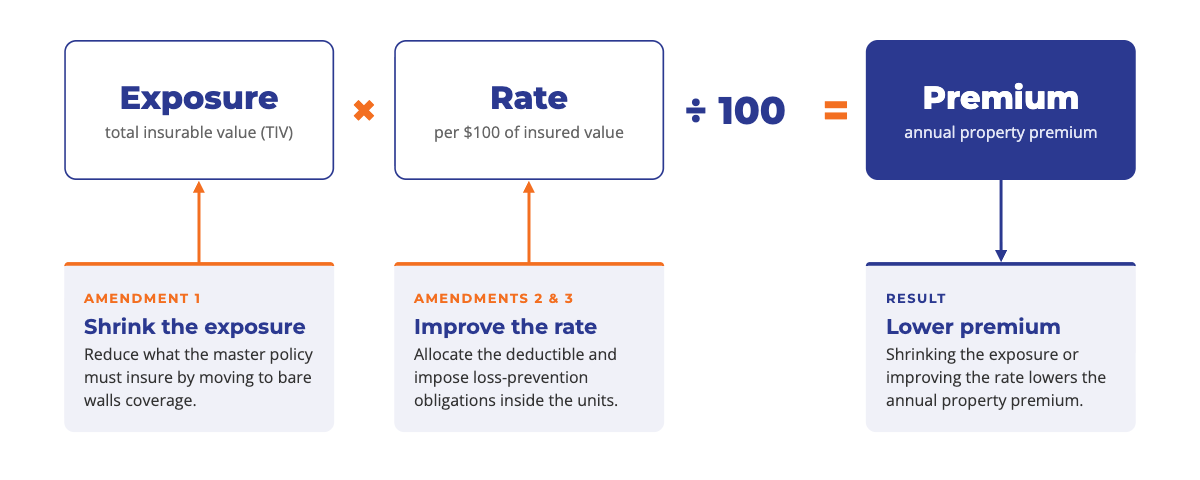
- Reduce what the master policy must insure. Limiting the master policy to the bare walls minimum required by Section 12 of the Act reduces the exposure the association pays to insure.
- Allocate the deductible and require unit owner insurance. Establishing in advance who pays the deductible, and requiring owners to carry the insurance needed to pay it, allows the association to accept a higher deductible and keeps small claims off its loss history.
- Impose loss-prevention obligations inside the units. Requiring owners to address the in-unit components underwriters care about most gives the carrier recorded evidence that the risk is improving.
Each amendment requires a vote of the unit owners, and the steps are explained in How to Amend an Illinois Condominium Declaration below.
Why Premiums Keep Rising and How a Carrier Prices Your Condominium
Illinois associations are not alone. According to the Foundation for Community Association Research, 93% of community associations reported a premium increase at their last or current renewal, 23% had their property policy non-renewed or cancelled by the insurer, and 29% reported that the insurer forced high or per-unit deductibles at renewal. The pressure appears to be intensifying. In the Foundation’s 2023 survey, 91% of associations reported a premium increase, but only 11% reported that their property coverage had been cancelled or not renewed.
Before a board can change the number on the renewal, it helps to understand how that number is calculated. Put simply, a premium is the price of shifting risk from the association to an insurer, and the riskier the property, the more that shift costs. For property coverage, the premium is generally a function of two variables: the rate and the exposure. The rate is expressed per $100 of insured value, so the premium equals the rate multiplied by the exposure, divided by one hundred.
For example, a building with a total insurable value (“TIV”) of $8,000,000 and a rate of $0.30 per $100 of value carries an annual property premium of $24,000 ($8,000,000 ÷ 100 = 80,000; 80,000 × $0.30 = $24,000).
At the most basic level, then, an association can lower its property premium in two ways: (1) by reducing the exposure the association is insuring; or (2) by persuading the underwriter that the association is a better risk that deserves a lower rate.
Market conditions aside, some rating factors, such as distance from the fire department or the local crime rate, cannot easily be changed. But insurance professionals generally agree that four categories of premium drivers are within an association’s influence:
- What Is Insured and What It Is Worth. What the association insures, and how accurately it is valued.
- Claims History and Deductibles. The frequency and severity of claims over the prior five years, the association’s mitigation efforts, and the deductible.
- Condition of Building Systems. The condition of roofs, electrical systems and panels, HVAC, and plumbing, including the components located inside the units.
- Fire and Life-Safety Protection. Sprinkler systems, fire alarms, smoke detectors, and similar life-safety features.
Underwriting is also not purely a numbers exercise. Underwriters also make judgment calls that do not appear on any rating sheet, including whether a property’s condition is getting better or worse over time and whether the board has a track record of following through on the carrier’s loss-control recommendations. Insurance professionals commonly identify outdated electrical panels and grills (particularly charcoal grills) as among the most frequent reasons that associations experience major premium increases or lose coverage altogether, and the market has been moving toward “bare walls” coverage paired with deductible charge-backs to unit owners.
The Community Associations Institute (“CAI”) has long recommended that associations treat insurance as part of an integrated risk management program, and has noted that coverage gaps between association and owner policies can be minimized by making clear who owns, maintains, replaces, and insures each component of the community. Each of the first three premium drivers above is governed, in large part, by the Declaration. That is where an amendment can make a difference.
Amendment No. 1: Reduce What the Master Policy Must Insure
What the Act requires
The Act imposes detailed insurance requirements on residential condominium associations. Under Section 12(a)(1) of the Act, an association must maintain:
Property insurance (i) on the common elements and the units, including the limited common elements and except as otherwise determined by the board of managers, the bare walls, floors, and ceilings of the unit, (ii) providing coverage for special form causes of loss, and (iii) providing coverage, at the time the insurance is purchased and at each renewal date, in a total amount of not less than the full insurable replacement cost of the insured property, less deductibles . . . . 765 ILCS 605/12(a)(1).
Significantly, Section 12(b) provides that the association’s property insurance must include the units, the limited common elements (except as otherwise determined by the board), and the common elements, but “need not cover improvements and betterments to the units installed by unit owners.” 765 ILCS 605/12(b). If the association does insure improvements and betterments, any increased cost may be assessed against the units affected. 765 ILCS 605/12(b); see also 765 ILCS 605/9(b) (permitting the condominium instruments to provide that common expenses for insurance premiums be assessed on a basis reflecting increased charges for coverage on certain units).
The Act defines “improvements and betterments” broadly to mean “all decorating, fixtures, and furnishings installed or added to and located within the boundaries of the unit, including electrical fixtures, appliances, air conditioning and heating equipment, water heaters, built-in cabinets installed by unit owners, or any other additions, alterations, or upgrades installed or purchased by any unit owner.” 765 ILCS 605/12(b). At the same time, the common elements that the association must insure include “fixtures located within the unfinished interior surfaces of the perimeter walls, floors, and ceilings of the individual units initially installed by the developer,” but exclude “floor, wall, and ceiling coverings.” 765 ILCS 605/12(b).
In other words, the Act sets a floor: the common elements (including the original fixtures within the unfinished walls, floors, and ceilings) and the bare walls, floors, and ceilings of the units. It does not, however, require the association to insure the decorating, floor and wall coverings, owner-installed cabinets and appliances, and other upgrades within each unit. How far above that floor the master policy extends is left largely to the Declaration. Because the statutory definitions do not neatly address every finish originally installed by the developer, an amendment should identify specifically which items each party insures.
What older Declarations often say
Practitioners generally describe three levels of master policy coverage:
| Coverage level | Master policy (association) insures | Unit owner’s HO-6 policy (the standard condominium unit owner’s policy) insures |
|---|---|---|
| “All In” | The common elements, the interior of each unit, and all fixtures, including improvements and upgrades made by the unit owners | Generally only personal belongings and personal liability |
| “Single Entity” or “Walls In” | The common elements and the unit interiors as originally constructed | Later upgrades made by the unit owners |
| “Bare Walls” | The common elements and the units only to the bare walls, floors, and ceilings | Everything inside the unit (other than the common elements the Act requires the association to insure), including appliances, cabinets, floor and wall coverings, and improvements |
Many Declarations recorded decades ago require “All In” or “Single Entity” coverage. Because the Declaration must be enforced as it is written, a board cannot simply instruct its broker to quote a bare walls policy if the Declaration requires the association to insure the unit interiors. The Declaration must be amended first.
Why the carrier cares
Recall that premium is a function of rate multiplied by exposure. Every dollar of unit interior that comes off the master policy is a dollar of exposure that is no longer being priced. Underwriters and valuation services generally distinguish between a “shell” valuation, which includes the foundation, load-bearing walls, roof, structural framing, and exterior finishes, and a fuller valuation that adds interior finishes such as carpeting, tile and hardwood flooring, cabinetry, and appliances.
Example: What bare walls coverage can save
To illustrate, if the unit interiors and finishes in a 100-unit building account for $4,000,000 of insured value, removing them from the master policy at a rate of $0.30 per $100 would reduce the annual property premium by approximately $12,000.
The larger the building, and the more upgraded the units, the larger that number becomes. Because the TIV drives the premium, boards should also confirm that the remaining shell value is accurate; only 21% of associations report having an insurable value appraisal on file (Foundation for Community Association Research, 2025).
A bare walls amendment also resolves a recurring source of disputes. Under a “Single Entity” provision, it is often impossible, years after construction, to determine which items in a unit are original and which are upgrades. Those disputes slow claims and frustrate underwriters. And because the Act makes the association’s policy primary whenever a unit owner has other insurance on the same property (765 ILCS 605/12(f)), an “All In” Declaration combined with owners who carry robust HO-6 policies means that the community is paying twice to insure the same kitchen.
Drafting considerations
A bare walls amendment should accomplish at least three things. First, it should define the association’s insurance obligation by reference to the Section 12(a)(1) minimum and expressly exclude improvements and betterments as permitted by Section 12(b).
Second, it should require each unit owner to insure everything the association no longer insures.
A clear, mandatory owner insurance requirement also protects the association if a dispute arises after a loss.
In a recent nonprecedential order, the Illinois Appellate Court held that a unit owner’s own property insurer was not a “collateral source” that would prevent the association from obtaining a setoff for amounts the owner had already recovered from that insurer, reasoning that individual unit coverage “shifts the risk of loss away from the condominium association and other unit owners to insurance and better allocates risk depending on the extent of renovations within a unit or the value of property kept inside it.” Bd. of Dirs. of 1212 Lake Shore Drive Condo. Ass’n v. List, 2025 IL App (1st) 240638-U, ¶ 34, 2025 WL 303852 (nonprecedential order entered under Ill. S. Ct. R. 23(b)).
The owner in that case argued that the declaration merely advised owners to insure their units rather than requiring them to do so. List, 2025 IL App (1st) 240638-U, ¶ 33. Although the court found that distinction was not controlling (List, 2025 IL App (1st) 240638-U, ¶ 34), a Declaration that expressly requires the coverage removes the argument altogether.
Third, the amendment should confirm that the maintenance, repair, replacement, and insurance responsibilities all align, so that whoever maintains an item also insures it and restores it after a loss.
Finally, the board should confirm with its broker that the revised structure continues to satisfy the secondary mortgage market, as Fannie Mae now requires a borrower to carry an individual unit owner’s policy whenever any portion of the unit’s interior or improvements is not covered by the master policy.
Amendment No. 2: Allocate the Deductible and Require Unit Owner Insurance
What the Act permits
Raising the deductible is one of the quickest ways to lower a premium, but most boards are reluctant to do so when every water leak from a unit becomes a common expense paid by the entire community.
The Act gives the board three options when a claim is made for damage to a unit or the common elements. Under Section 12(c), the board may:
- pay the deductible as a common expense;
- after notice and an opportunity for a hearing, assess the deductible against the unit owners who caused the damage or from whose units the damage or cause of loss originated; or
- require the unit owners of the units affected to pay the deductible. 765 ILCS 605/12(c).
The Act also permits an association to require unit owners to carry their own liability coverage. Under Section 12(h):
The board of directors may, under the declaration and bylaws or by rule, require condominium unit owners to obtain insurance covering their personal liability and compensatory (but not consequential) damages to another unit caused by the negligence of the owner or his or her guests, residents, or invitees, or regardless of any negligence originating from the unit. The personal liability of a unit owner or association member must include the deductible of the owner whose unit was damaged, any damage not covered by insurance required by this subsection, as well as the decorating, painting, wall and floor coverings, trim, appliances, equipment, and other furnishings. 765 ILCS 605/12(h).
Why amend if the Act already provides these tools?
Because the board’s statutory options are only as useful as the Declaration is clear. Many older Declarations provide that all deductibles are a common expense, are silent on the issue, or conflict with the Act. A board that decides on a case-by-case basis, after the loss, whether to charge a deductible back to a unit owner invites disputes, claims of selective enforcement, and owners who learn for the first time after a loss that their HO-6 policy does not cover the charge.
An amendment that establishes, in advance, that the deductible for any loss originating within a unit will be charged back to that unit, regardless of negligence and after the notice and hearing required by Section 12(c), allows every owner to purchase the right coverage before the loss occurs.
The amendment should be paired with a mandatory unit owner insurance provision. Section 12(h) expressly authorizes the board, under the Declaration and bylaws or by rule, to require owners to carry personal liability coverage for damage to another unit originating from their unit, which must include the deductible of the owner whose unit was damaged. 765 ILCS 605/12(h).
Section 12(h) does not separately address a requirement that owners carry property coverage on their own units, so that requirement should rest squarely on the Declaration.
The amendment should require each owner to carry: (1) an HO-6 policy (or, for leased units, the equivalent policy) covering the portions of the unit the association does not insure; (2) the personal liability coverage authorized by Section 12(h); and (3) loss assessment coverage in an amount at least equal to the association’s deductible (or, if the master policy has a per-unit deductible, that per-unit deductible). The amendment should also require proof of coverage upon request and authorize the association to treat any deductible charge-back as an assessment against the unit, collectible in the same manner as other common expenses.
Why the carrier cares
Claims history and deductibles are among the premium drivers a board can most directly influence, and carriers pay close attention to how often an association files claims, not merely how large those claims are. In the condominium setting, frequency is driven largely by water losses that originate in individual units, such as a failed supply line, an overflowing toilet, or a water heater that has reached the end of its useful life.
When the first several thousand dollars of every such loss is borne by the owner of the unit where the loss originated (or by that owner’s carrier), two things happen. First, the association can accept a higher deductible, which reduces the premium directly. Second, small claims stop being submitted to the master policy, which improves the association’s five-year loss history, one of the first things an underwriter reviews at renewal.
Notably, as of 2023, fewer than half of condominium associations (47%) required owners to carry an individual HO-6 policy (Foundation for Community Association Research, 2023). In 2025, CAI urged the Federal Housing Finance Agency to replace the secondary mortgage market’s per-unit deductible limits with a requirement that unit owners carry HO-6 policies. Fannie Mae’s 2026 changes moved in that direction: when a master policy includes a per-unit deductible, the borrower must now carry a unit owner’s policy with coverage at least equal to that deductible.
Drafting considerations
The deductible should be set with an eye on the secondary mortgage market. Fannie Mae now caps the maximum allowable per-unit deductible under a master property policy at $50,000 per unit for loan applications dated on or after July 1, 2026. Boards should also communicate the change to the owners well before the amendment’s effective date. The standard loss assessment coverage included in many HO-6 policies is only $1,000 to $2,000, and some policies sublimit the portion that pays a master policy deductible, so owners should give their insurance agent a copy of the amendment and confirm their coverage is adequate.
Amendment No. 3: Impose Loss-Prevention Obligations Inside the Units
The problem
Even a bare walls policy still insures the building, and the building can be lost because of a component that the association does not own, does not maintain, and may never have seen. Underwriters evaluate the condition of building systems throughout the property, including those located inside the units, and outdated plumbing and electrical systems are common underwriting red flags. According to the Foundation for Community Association Research, 27% of associations reported water or fire claims, and some reported aluminum wiring (5%) or Stab-Lok electrical panels (3%). The loss-control measures that carriers and brokers most commonly recommend read like a checklist of items located inside the units:
- Replacement of Federal Pacific “Stab-Lok” panels and other electrical equipment that carriers consider high-risk;
- Scheduled replacement of aging water heaters;
- Braided stainless steel hoses on washing machines and ice makers;
- Leak sensors and automatic water shut-off valves;
- Alarms that warn of low temperatures inside a unit, along with procedures for winterizing vacant units; and
- Working smoke detectors and fire extinguishers in every unit.
Why a Declaration amendment, rather than a rule
Most Declarations make the unit owner responsible for maintaining the interior of the unit, but say little about how it must be maintained. A board may adopt rules under Section 18.4(h) of the Act, but only after a meeting of the unit owners called to discuss them, and no rule may “conflict with the provisions of this Act or the condominium instruments.” 765 ILCS 605/18.4(h).
Moreover, the level of deference a court will give a restriction depends on where it is found. When a restriction is approved by the owners and made part of the Declaration, Illinois courts presume it is valid and will uphold it “unless it can be shown that the restriction is arbitrary, against public policy or violates some fundamental constitutional right of the unit owners.” Apple II Condo. Ass’n v. Worth Bank & Tr. Co., 659 N.E.2d 93, 99 (Ill. App. Ct. 1995); accord Wood v. Evergreen Condo. Ass’n, 2021 IL App (1st) 200687, ¶ 19, 189 N.E.3d 1045, 1051.
By contrast, when a restriction is adopted by the board alone, a court will “scrutinize the restriction and uphold it only if it is affirmatively shown to be reasonable in its purpose and application.” Apple II, 659 N.E.2d at 99; see also Bd. of Dirs. of 175 E. Del. Place Homeowners Ass’n v. Hinojosa, 679 N.E.2d 407, 411 (Ill. App. Ct. 1997) (applying the Apple II standard to a board-adopted rule).
And where a board rule conflicts with the Declaration, the rule is invalid regardless of whether it is reasonable. Stobe v. 842-848 W. Bradley Place Condo. Ass’n, 2016 IL App (1st) 141427, ¶¶ 15, 20, 23, 48 N.E.3d 310.
Where an obligation will require owners to spend money inside their units (replacing an electrical panel or a water heater, for example), the obligation belongs in the Declaration. Once recorded, such an amendment binds existing owners as well as future purchasers. Purchasers are charged with knowledge that the Declaration may be amended, and absent a provision in the Declaration or the amendment to the contrary, owners “do not have vested rights in the status quo ante.” Apple II, 659 N.E.2d at 97.
What the amendment should include
A loss-prevention amendment would typically:
- Require unit owners to replace identified high-risk components, such as Federal Pacific Stab-Lok or other carrier-identified electrical panels, by a specified deadline;
- Require water heaters to be replaced at or before the end of their manufacturer-rated useful life, and require braided stainless steel supply lines on washing machines, dishwashers, ice makers, and toilets;
- Require leak detection devices or automatic shut-off valves where appropriate for the building;
- Require that heat be maintained at a minimum temperature during the heating season and that vacant units be periodically inspected;
- Restrict or prohibit charcoal grills and other open-flame cooking devices on balconies, patios, and decks, consistent with any applicable local fire code;
- Provide the association with a right of entry, on reasonable notice, to verify compliance, supplementing the association’s statutory right of access to units for the maintenance, repair, or replacement of the common elements and for emergency repairs (765 ILCS 605/18.4(j)); and
- Authorize the association to perform the required work if an owner fails to do so and to charge the cost back to that unit.
Before imposing any of these obligations, the board should confirm who owns and maintains each component. Under the Act, the common elements include fixtures initially installed by the developer within the unfinished interior surfaces of the perimeter walls, floors, and ceilings of the units (765 ILCS 605/12(b)), and many Declarations treat pipes, wires, and other components serving only one unit as limited common elements. Each obligation in the amendment should match the ownership and maintenance allocation in the Declaration, or the amendment should expressly reallocate that responsibility to the unit owner.
Why the carrier cares
These obligations work on the rate side of the premium formula rather than the exposure side. An underwriter wants confidence that a property is becoming safer over time and that the board will follow through on recommended improvements. A Declaration that requires owners to eliminate known hazards, and that gives the board the tools to enforce those requirements, is concrete evidence of both, in recorded form. Boards should also ask their broker whether premium credits are available for specific loss-control measures, so that the board can quantify the return on each requirement before it is drafted.
How to Amend an Illinois Condominium Declaration
Each of the three amendments described above requires a vote of the unit owners. Under Section 27(a)(i) of the Act, the condominium instruments may be amended “upon the affirmative vote of 2/3 of those voting or upon the majority specified by the condominium instruments, provided that in no event shall the condominium instruments require more than a three-quarters vote of all unit owners.” 765 ILCS 605/27(a)(i). The board should therefore begin by reviewing the amendment article of its Declaration to determine the applicable threshold.
Unlike the laws of some other states, the Act does not itself require mortgagee approval of an amendment that shifts insurance responsibility. However, many Declarations contain mortgagee-protection provisions that require mortgagee consent for amendments affecting insurance. Where the Declaration requires that consent, Section 27(a)(ii) provides that a mortgagee or lienholder of record is deemed to have approved the amendment unless it delivers a negative response within sixty days after the request is mailed, and the request must be sent by certified mail. 765 ILCS 605/27(a)(ii). The board should also keep the following in mind:
Follow the notice requirements to the letter. The Illinois Appellate Court has invalidated an amendment adopted at a meeting for which notice was addressed generally to “all unit owners” and sent by regular mail, when the Declaration required notice addressed to each owner entitled to vote and delivered by registered or certified mail (or to the unit), and one of the owners never received notice at all. Gunnison Commons, LLC v. Alvarez, 2024 IL App (1st) 232176, ¶¶ 29–30, 247 N.E.3d 1182.
Record the amendment. An amendment is effective upon recording unless it sets forth a different effective date. 765 ILCS 605/17(a). Boards should consider setting an effective date that coincides with the association’s policy renewal and that gives owners time to adjust their HO-6 coverage.
Take a holistic approach. As discussed above, the insurance article should not be amended in isolation; the maintenance, repair, replacement, and insurance responsibilities for each component should align.
Involve the broker early. Carriers price a condominium largely from the property information and description that the broker submits, so the quality of that submission affects both whether carriers will quote the account and what they charge. A recorded amendment helps at renewal only if the broker features it in that submission.
Conclusion
There is little reason to expect condominium premiums to fall on their own any time soon, and many of the forces pushing them higher are beyond any board’s reach. But a premium is not simply a number that arrives with the renewal. It is the product of what the association insures, how its losses are allocated, and whether the underwriter believes the risk is improving. Each of those inputs is shaped by the Declaration.
For the board treasurer asking what can be changed after another premium increase, part of the answer may lie in a place the board has not thought to look: the Declaration. Three amendments in particular can make a difference: (1) reduce the master policy to the bare walls minimum required by Section 12 of the Act; (2) establish, in advance, who pays the deductible and require owners to carry the insurance needed to pay it; and (3) impose enforceable loss-prevention obligations on the components inside the units that underwriters care about most.
A board looking for relief at its next renewal should have experienced community association counsel and the association’s insurance broker review the Declaration together to determine which of these amendments fits the community.