Illinois condominium association boards frequently face difficult decisions when unexpected building repairs arise, especially when those repairs require large special assessments. A recent Illinois appellate decision provides important guidance on when an Illinois condominium board may impose a significant special assessment without first obtaining unit owners’ approval. In Dedic v. Bd. of N. Shore Towers Condo. Ass’n, 2018 IL App (1st) 171842, 105 N.E.3d 821, the Illinois Appellate Court addressed whether an Illinois condominium association board properly exercised its authority when it imposed a $1.01 million special assessment to repair deteriorating balconies without allowing the unit owners to vote on the assessment. The decision provides valuable clarification for Illinois condominium associations regarding the “emergency” and “mandated by law” exceptions under 765 ILCS 605/18(a)(8)(ii) of the Illinois Condominium Property Act.
Background of the Emergency Special Assessment Condo Dispute
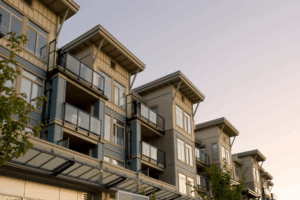
The dispute arose at North Shore Towers Condominium Association, a 90-unit residential condominium complex in Skokie, Illinois. After unit owners began reporting problems with certain balconies, the board retained a structural engineering firm to evaluate the condition of the building’s balconies. The engineer’s investigation revealed widespread deterioration. The report documented corrosion, damage to steel components, and structural issues with the balcony railings. In particular, the engineer concluded that 56 of the building’s 90 balconies had railings that likely could not withstand the 200-pound load required by the local building code, creating a significant safety concern. Based on these findings, the board adopted a $1.01 million special assessment to repair and remediate the balconies. A unit owner, Selma Dedic, objected to the assessment and argued that the board could not impose such a large special assessment without a vote of the unit owners. Under 765 ILCS 605/18(a)(8)(ii) of the Illinois Condominium Property Act, if a special assessment exceeds 115% of the prior year’s assessments, unit owners holding 20% of the votes may petition for a meeting to reject the assessment. Dedic and other unit owners obtained the necessary signatures and demanded a vote. The board refused. The board argued that the repairs qualified under the statutory exceptions for “emergencies” or expenses “mandated by law,” which allow a condominium board to impose a special assessment without a unit owner referendum. Dedic then filed a lawsuit seeking an injunction to stop the assessment. After a bench trial, the circuit court denied the unit owner’s request for a permanent injunction. The court concluded that the balcony conditions posed an immediate safety risk and therefore constituted an emergency under both the condominium declaration and the Illinois Condominium Property Act. Because the assessment addressed an emergency and conditions required to comply with the law, the court held that the board could proceed with the special assessment without a unit owner vote. The unit owner appealed.
Illinois Condominium Associations Can Make Emergency Repairs under 765 ILCS/18
The Illinois Appellate Court affirmed the trial court’s decision. The court emphasized that the definition of an “emergency” under 765 ILCS 605/18(a)(8)(ii) of the Illinois Condominium Property Act includes: …an immediate danger to the structural integrity of the common elements or to the life, health, safety, or property of the unit owners. The evidence presented at trial showed that the balcony railings on 56 condominium balconies could not withstand the required 200-pound load, creating a risk that a person could fall if the railing failed. The court determined that this condition constituted a safety hazard sufficient to qualify as an emergency. The court also noted that the repairs were necessary to bring the balconies into compliance with applicable building code requirements. Because the conditions violated legal safety standards, the remediation was also “mandated by law.” Additionally, the court rejected the argument that the project was primarily preventative maintenance. The evidence showed that 80–85% of the project cost was required to repair the most dangerous balconies, while only a small portion of the work involved preventative measures. Based on this record, the appellate court concluded that the condominium board acted within its authority and properly imposed the special assessment without submitting the matter to a unit owner vote.
Key Takeaways for Illinois Condominium Associations
This decision highlights several important principles for Illinois condominium boards and community association managers.
- Emergency repairs in Condominium Associations can justify bypassing unit owner voters.
Under 765 ILCS 605/18(a)(8)(ii) of the Illinois Condominium Property Act, condominium boards may impose special assessments without a unit owner vote when the expenditures address an emergency or are mandated by law. Courts will defer to the board’s decision when credible expert evidence shows that building conditions pose a safety risk.
- Safety risks are not limited to structural collapse of a Condominium.
The court made clear that an emergency does not require imminent structural failure of the condominium building. A condition that creates a significant risk of injury, such as a balcony railing incapable of supporting required loads, can also qualify as an emergency.
- Condo Board Members should rely on Expert AdviceThe court relied heavily on the testimony and reports of structural engineers who evaluated the balconies. Condominium boards should document their decisions by obtaining expert evaluations before undertaking major repair projects, thereby affording them protection under the business judgment rule.
Practical Guidance for Illinois Condominium Boards
When facing large repair projects, Illinois condominium boards should take proactive steps to protect the association and reduce the risk of legal challenges.
- Obtain qualified engineering or professional reports
Illinois Condominium associations that face large repair projects should obtain qualified engineering or professional reports to document the property’s condition and the need for repairs.
- Consult experienced counsel to review the governing documents and applicable statutes
Illinois condominium associations should consult experienced condominium counsel to carefully review the association’s governing documents and the Illinois Condominium Property Act (765 ILCS 605/1) to determine whether the repair qualifies as an emergency or a legally mandated repair. This will ensure that any special assessment adoption complies with the governing documents and any applicable law.
- Maintain detailed records
Illinois condominium associations should maintain detailed records showing how the board evaluated the issue, including meeting minutes, expert reports, and cost estimates. Consistent documentation can be a key factor in the event of litigation.
- Communicate openly with unit owners.
Illinois condominium associations should communicate openly with unit owners. While emergency projects may not require a vote, transparency can help prevent disputes and build trust within the community.
Conclusion
The appellate court’s decision in Dedic v. Board of North Shore Towers Condominium Association provides clarity for Illinois condominium association boards seeking to adopt special assessments to address deteriorating physical conditions. The court’s decision emphasizes that Illinois condominium boards have the authority and the fiduciary duty to act promptly when building conditions threaten residents’ safety. The decision provides valuable clarification for Illinois condominium associations regarding the “emergency” and “mandated by law” exceptions under the Illinois Condominium Property Act ( 765 ILCS 605/18(a)(8)(ii)). When credible evidence demonstrates that a repair project addresses an emergency or is mandated by law, the Illinois Condominium Property Act allows boards to impose necessary special assessments without a unit owner referendum. Illinois condominium association boards that are seeking to adopt a special assessment to address failing property conditions should consult the experienced condominium attorneys at Hirzel Law, PLC, to determine the proper course of action.